Vietnam 2026

Vietnam 2026

HCMC · Mũi Né · Đà Lạt · Highlands · Hội An · Huế · Phong Nha · Ninh Bình · Hà Giang · Cao Bằng · Ba Bể · ...

A travel journal — the trip as it unfolds

The journal of a solo trip through Vietnam that became something bigger. What started in Ho Chi Minh City turned into a group adventure — Issy, Marcella, Severine, Tom, and Brad all joined along the way. Six weeks riding together through the Central Highlands, over Lo Xo Pass, through Hội An, Huế, and Phong Nha. The group split at Pù Luông on 20 March. Aaron continued north — the Hà Giang Loop solo through the karst plateau, east into Cao Bằng province near the Chinese border, and now south to Ba Bể Lake — Vietnam's largest natural freshwater lake, mountain-ringed and nearly off the tourist radar.

Tap the map below to explore the route — each stop links to its story. This page grows as the trip does.

The Route

Tap a stop to jump to that part of the story

Completed Day trips Next Proposed

Now

Ba Bể Lake — Pác Ngòi Village

At Ba Bể Lake in Bắc Kạn province — one of Vietnam's largest natural freshwater lakes, ringed by karst mountains and thick forest. Staying in Pác Ngòi village, the main Tày village on the southwestern shore. Balcony views over rice paddies and limestone peaks. A few days here — private boat through the lake's caves and hidden villages, kayaking, and photography.

The Plan

Boat, kayak, villages — timing around the weather

🚣
Boat Day — Private Lake & River Tour Aaron's suggested a private boat through Ba Bể Lake and up the Nang River — flexible route, no fixed itinerary, stopping wherever looks interesting. The idea is to hit the villages and stops that the standard cooperative tour boats skip. 🌅 Early morning departure — mist on the lake, fishermen in dugout canoes, reflections off the karst. Best conditions for photography. The suggested route: Widow's Island (Bà Góa) — A limestone outcrop rising from the lake. Named after a Tày legend about a compassionate widow whose house survived the flood that created Ba Bể. The silhouette against morning mist is the classic Ba Bể image. An Mạ Temple — A small temple on a tortoise-shell-shaped limestone island, honouring Mạc dynasty loyalists who fled here centuries ago. Panoramic lake views from the top. Cốc Tọc Village — A Tày fishing village tucked in forest on the lakeside, far quieter than Pác Ngòi. Fishermen still use traditional dugout canoes (độc mộc — carved from a single tree trunk). Most tour boats don't stop here. Nang River → Puông Cave — The river flows straight through a 300m limestone cavern. The boat enters through a dramatic mouth — stalactites overhead, thousands of bats (18 species) roosting in the dark above. Late afternoon (~5pm) is when the bats emerge in massive swarms. Bản Cám Village — Tày village on the Nang River, on the way to the cave. Stilt houses along the water, traditional fishing. Tour boats pass through but rarely stop — with a private boat, it's a natural add. Extension option: Continue upstream past Puông Cave to Đầu Đằng Waterfall — 500m of cascading rapids through thick jungle, with a walking path and local vendors grilling fish along the way. Adds ~2 hours round trip. Worth it for the river journey as much as the waterfall itself. Timing depends on weather — aiming for the first clear morning. 🗺️ Navigate to Puông Cave
🛶
Kayak Day A separate day on the water — paddling the lake at a different pace. The lake is glass before 7am. Paddle toward the cliff faces on the eastern shore for the best light, or loop around the islands. Sunset from the water is supposed to be the highlight.
?
On Foot or Motorbike — If Time Allows Hủa Mạ Cave — 10 km south by motorbike. Dramatic stalactites resembling terraced rice fields, sweeping views of the lake and forest from the entrance. Half-day trip. Hmong mountain villages — Trek from Bó Lù or Cốc Tọc straight up the mountain to Nà Phải, Đán Mẩy, or Nậm Dài. Traditional Hmong houses, corn farming, embroidery and batik. Very few tourists make this trek. Village cycling — Ride through the rice paddies and nearby Tày hamlets on a rented bicycle. Flat and easy. Sunrise from the rice fields — 5:45am, mist drifting over stilt houses and the lake. One of Ba Bể's signature moments. 🗺️ Navigate to Hủa Mạ Cave
After Ba Bể — Hanoi When it's time, the ride south to Hanoi via Bắc Kạn and Thái Nguyên. ~240 km, a full day's ride. The classic northeast loop closure: Hà Giang → Cao Bằng → Ba Bể → Hanoi. 🗺️ Navigate to Hanoi

The Lake & Its People

🌏
Ba Bể — Three Lakes "Ba Bể" means "three lakes" in the Tày language — three connected sections (Pé Lầm, Pé Lù, Pé Lèng) stretching 9 km through karst mountains and primary forest. Vietnam's largest natural freshwater lake, at 145m elevation. Three ethnic groups live around the lake: the Tày (stilt houses, fishing from dugout canoes, đàn tính music, indigo-dyed cotton), the Dao (red headscarves, herbal medicine, silverwork), and the Hmong (high-altitude corn cultivation, embroidery, batik). Three islands on the lake: An Mạ (temple), Khau Cum (small islet), and Bà Góa — Widow's Island.

Practical

📋
Ba Bể — Good to Know Cash: Nearest ATM is in Chợ Rã (~18 km). Homestays are cash only. Connectivity: WiFi at most homestays but patchy. Viettel 4G is the most reliable. Boat trips: Arranged through the homestay. A private boat offers flexible routes — go where you want, stop for photos, linger at villages. Bring on the boat: Dry bag for camera gear (afternoon rain possible), snacks and water (no restaurants on the lake), swimwear. Best light: Sunrise ~5:45am (mist on the lake). Sunset ~6:15pm. Bat emergence from Puông Cave ~5pm. Bring: Headlamp (caves, power cuts), insect repellent (mosquitoes at dusk), rain jacket.

Cao Bằng: Bảo Lạc, Khau Cốc Chà, Phúc Sen blacksmith, Angel Eye Mountain, Ngườm Ngao Cave, Khuổi Ky, God's Eye cavern ✅ done


The Journal

The trip as it happened — latest first


The Journey So Far

It started in Ho Chi Minh City on 9 February — a solo backpacking trip that became a group adventure. Two weeks in Mũi Né through Tết, then the group came together in Đà Lạt: Aaron, Issy, Marcella, Severine, and Tom. They rode south through coffee country to Lak Lake, stayed in an M'nong stilt house, and continued to Buôn Ma Thuột for waterfalls and ethical elephant observation at Yok Đôn. Through the deep highlands and over Lo Xo Pass to Hội An, where Brad joined. North together over Hải Vân Pass to Huế, then Phong Nha for the caves. From there, everyone scattered — Brad south, Issy and Sev toward Hanoi, Aaron and Tom riding north through tea hills to Ninh Bình, then Pù Luông. After the group split on 20 March, Aaron crashed the bike, swapped it in Hanoi, and continued to Hà Giang for the famous loop — Heaven's Gate, Lũng Cú, Đồng Văn, Mã Pì Lèng Pass. Then east into Cao Bằng province — Bảo Lạc, the blacksmith village at Phúc Sen, Angel Eye Mountain, the Bản Giốc area and caves, and climbed into the God's Eye cavern. Now at Ba Bể Lake — exploring by boat, kayak, and on foot before the return to Hanoi.

Saigon — Done

9–10 Feb. Flew in from Perth. First hostel, first banh mi, first night out in the backpacker district. The city was electric but overwhelming — two days later, a train south to the coast. Read the story.

Mũi Né Through Tết — Done

11–22 Feb. Twelve days in a beach town on the southeast coast. Rented a scooter, rode the sand dunes, stayed put through Vietnamese New Year. Met Mark and Jenny. Got sick from balut. Started writing fiction for the first time. Read the story.

Đà Lạt — The Crew Forms — Done

23–27 Feb. Five solo days in the highlands. Canyoning, picked up the motorbike, explored coffee farms and waterfalls. Severine, Marcella, Issy, and Tom all appeared at Tigon Hostel. The group came together. Read the story.

Đà Lạt → Lak Lake → BMT — Done

Sat 28 Feb through Wed 4 Mar. The full group: Aaron, Issy, Marcella, Severine & Tom. Night market in Đà Lạt, Easy Riders through coffee country to Lak Lake, M'nong homestay, waterfalls, Yok Don elephants. Scroll down for the day-by-day.

BMT → Deep Highlands — Done

Thu 5 Mar. The group split up. Marcella headed to Hoi An — she'd said from the start she wanted to spend time there. Issy and Severine caught a bus to Quy Nhon on the coast. Aaron and Tom saddled up the bikes and rode north through Pleiku, past the volcanic crater lake of Biển Hồ, and into Ba Na territory.

Lo Xo Pass → Hoi An — Done

Fri 7 – Sat 8 Mar. Aaron and Tom rode the Ho Chi Minh Highway north from the highlands — Lo Xo Pass, jungle switchbacks, overnight in Khâm Đức, then the descent to the coast via QL14B. The full route.

Hoi An — Done

Sun 9 – Tue 11 Mar. The group reunited in Hoi An — Aaron, Tom, Issy, Severine, and Marcella all back in the same place. Met Brad at the hostel, who joined the crew. Lantern-lit streets, ancient town, beach days at Ha My.

Hai Van Pass → Huế — Done

Tue 11 Mar. Aaron, Tom, Issy, and Marcella rode through Hai Van Pass with Easy Riders guides. Rained most of the way — arrived soaked but happy. Oysters and a vegetarian lunch en route. Severine and Brad bussed straight through to Phong Nha.

Huế → Phong Nha — Done

Wed 12 Mar. Aaron and Tom rode the bikes through cold rain. Marcella rode pillion with Aaron. Issy bussed from Huế. Severine and Brad had already bussed through from Hoi An. Everyone reunited in Phong Nha.

Phong Nha Caves — Done

Thu 12 – Sat 15 Mar. The last stop with the full group. UNESCO caves, Dark Cave (zipline, mud bath, kayak), Paradise Cave, Bong Lai Valley loop. Based at Central Backpackers Hostel. Brad headed south by sleeper bus on Saturday night. Issy and Sev headed north toward Ninh Bình. Aaron and Tom rode on together.

Gio Lao → Ninh Bình — Done

Mon 16 Mar. Aaron and Tom rode ~300 km in one day — Ho Chi Minh Highway through the scenic highlands, then cutting east to the main highway at Thanh Hóa for the push into Ninh Bình. Reunited at Tam Cốc.

Ninh Bình — Done

Tue 17 Mar. Sunrise hike up Dragon Mountain (Mua Cave) with Aaron, Tom, Sev, and Alicia. Karst landscapes, rice paddies, boats through caves. Two nights in Ninh Bình before heading to Pu Luong.

Pu Luong — Done

Wed 18 – Thu 19 Mar. Two nights at the Gateway Inn in Pu Luong Nature Reserve — rice terraces, karst valleys, a half-marathon circuit around the reserve. The last place all four (Aaron, Tom, Sev, Issy) were together.

🔀

The Group Splits — 20 Mar

After six weeks together, the group disbanded at Pu Luong. Sev headed to Hanoi, then doing a 3-day Hà Giang tour. Issy headed to Hanoi for a week. Tom and Aaron continued north together on bikes.

Pu Luong → Phú Thọ — Done

20–21 Mar. Aaron and Tom rode north from Pu Luong. The XR150 hit a drainage ditch on a bend — Aaron walked away with a few scratches, but the front wheel was bent. A local mechanic appeared and patched it roadside. They continued to Phú Thọ province, where Tom visited a local family to deliver money raised by friends back home.

Hanoi — Bike Swap — Done

21 Mar. Quick detour to Tigit Motorcycles in Hanoi to swap Aaron's damaged XR150 for a fresh one. Back on the road the same day, riding northwest through the tea hills.

Tuyên Quang — Done

21 Mar. Overnight in Tuyên Quang — a riverside city in the northern midlands. Tea plantations, orange orchards, and the transition from the Red River Delta into proper mountain country.

Hà Giang Loop — Done

23–28 Mar. Aaron rode the Hà Giang Loop — Vietnam's most spectacular mountain road through the UNESCO Global Geopark. Heaven's Gate at Quản Bạ, the northernmost point at Lũng Cú, Đồng Văn old town, and the showstopper — Mã Pì Lèng Pass, a cliff road carved by hand in the 1960s with 1,000+ metre drops to the turquoise Nho Quế River gorge below. Several days in Mèo Vạc to recover and explore.

Cao Bằng — Explored

29 Mar – 1 Apr. After Mèo Vạc, rode east through Bảo Lạc and the Dragon's Stairway hairpins to Cao Bằng City. Based at Primrose Homestay for four nights — visited Phúc Sen blacksmith village, Angel Eye Mountain (Mắt Thần Núi), and the Khau Cốc Chà viewpoint.

Bản Giốc Area & God's Eye — Done

1–2 Apr. Explored the Bản Giốc area east of Cao Bằng — Ngườm Ngao Cave, the Tày stone village at Khuổi Ky, and the countryside along the Chinese border. Went back to God's Eye Mountain (Mắt Thần Núi) on the second day and climbed up into the cavern itself — the natural hole through the karst peak.

📍

Now — Ba Bể Lake

At Ba Bể Lake in Bắc Kạn province — three connected mountain lakes in a national park, nearly untouched. Staying in Pác Ngòi village in a Tày homestay overlooking rice paddies and karst mountains. Planning a private boat through the lake's caves and hidden villages, kayaking, and photography. Full plan & boat itinerary.

Hà Giang & The Northeast

The famous Hà Giang motorbike loop — arguably the best motorcycle route in Southeast Asia. Several days through the UNESCO Global Geopark. Karst plateaus, mountain passes, H'mong villages, and roads clinging to cliff faces a thousand metres above river gorges. Then east into Cao Bằng province — one of the most remote corners of the country. Blacksmith villages, cave systems, and Vietnam's largest waterfall on the Chinese border.

The Loop — Sequenced Stops

The route in order. No fixed timeline — take as long as you want at each stop. Homestays are everywhere, no booking needed.

🏁

1. Hà Giang City — Launch Pad

Starting point for the loop. Pick up the border travel permit at the immigration office — 20 minutes, need passport and bike plate number. Get an oil change and chain check on the bikes. Stock up on supplies and fuel. The city itself isn't the attraction — it's the gateway.

Border permit required · Fuel up · Immigration office near the centre

Stay — Budget: Ha Giang Hostel — dorms and privates available. Pool with mountain views. Rated 9.5 on Booking. The social hub where most loop riders start.

Stay — Nicer: Eco Stone House (where Aaron and Tom stayed 22 Mar). Or Four Points by Sheraton — Ha Giang's first international hotel, indoor pool, spa, sauna.

⛰️

2. Quản Bạ — Heaven's Gate

The first major viewpoint. The road climbs steeply out of Hà Giang into the mountains. At the top: panoramic views over the karst valley and the "Fairy Bosom" — two perfectly symmetrical green hills in the valley below. The moment you know you're somewhere special.

~45 km from Hà Giang · Homestays in Quản Bạ town

Stay — Budget: Hong Thu Homestay & Bungalow — family rooms with balconies and mountain views. Walking tours available.

Stay — Nicer: Limited options here. Most accommodation is homestay-level. If comfort is the priority, Quản Bạ works better as a scenic lunch stop — push through to Yên Minh or Đồng Văn for the night.

🧵

Lùng Tám — H'mong Hemp Village

A H'mong weaving cooperative near Quản Bạ where women grow hemp, spin it into thread, weave fabric, and hand-draw intricate wax-resist batik patterns before dyeing with indigo. One of the most authentic craft experiences on the loop — the entire process from raw plant to finished textile, done by hand the same way it has been for generations.

Near Quản Bạ · Short detour off the main road

🏘️

3. Yên Minh

Mountain market town and natural overnight stop. H'mong villages in the surrounding valleys. Simple homestays in and around town. The road between Quản Bạ and Yên Minh is already spectacular — winding through karst formations with valleys dropping away on both sides.

~90 km from Hà Giang · Fuel available · Homestays available

Stay — Budget: Bong Bang Homestay — home-cooked family meals. Authentic and simple.

Stay — Nicer: Yên Minh is a transit town — clean hotels but nothing fancy. No bathtub options. If you want comfort, push the extra 1.5 hours to Đồng Văn where there are better options.

🏛️

4. Sà Phìn — H'mong King's Palace

Short detour off the main route. The Vương family palace — home of the historical H'mong chieftains. A unique blend of Chinese, French, and H'mong architecture, built with opium trade wealth in the early 1900s. Walled compound, ornate woodwork, mountain backdrop.

~15 km detour off the main road

🇻🇳

5. Lũng Cú — Northernmost Point

Vietnam's northernmost flag tower — a massive Vietnamese flag on a mountaintop right on the Chinese border. Views into China on one side, Vietnam on the other. Worth the detour for the bragging rights and the panorama.

~25 km detour north from the main loop

Stay — Budget: Lo Lo Chai village homestays — in the Red Lo Lo ethnic minority village at the foot of the flag tower. Walking distance to the climb.

Stay — Glamping: Sunrise Camping Lũng Cú — glamping tents on a hillside between terraced rice fields. Mountain views, designed for sunrise-watching. Bar and outdoor dining.

🏔️

6. Đồng Văn — Old Town

Stone-walled old quarter on the karst plateau, surrounded by towering limestone peaks. Sunday market is the highlight — H'mong, Dao, Tay, and Lo Lo ethnic minorities come down from the surrounding mountains. Misty mornings, lantern-lit alleys, excellent phở. One of the most atmospheric small towns in Vietnam.

~150 km from Hà Giang · Sunday market is the best · Homestays available

Stay — Budget: Hoang Ngoc Hotel — central location, AC, fridge. Walking distance to the Old Quarter. Clean and well-equipped.

Stay — Treat (🛁 Bath): Dong Van Golden Hotel — 3-star. Spa bathtub in triple/quad rooms. The best bathtub option on the entire loop. Bathrobes, free toiletries. ~10 min from the centre. Worth the splurge after a long day of riding.

🌫️

May Cave (Cloud Cave)

Roadside cave between Đồng Văn and Mèo Vạc — you'll pass it on the way to Mã Pì Lèng. The entrance is shaped like a giant lotus bud. When sunlight hits the water vapor inside, mist forms through the chambers. Quick stop, no detour needed.

Between Đồng Văn and Mã Pì Lèng · Free · Roadside access

🌄

7. Mã Pì Lèng Pass — The Highlight

This is it. One of the most spectacular mountain roads in the world. The road clings to the cliff face, carved by hand in the 1960s, with 1,000+ metre drops to the turquoise Nho Que River gorge below. Stop at the Mã Pì Lèng viewpoint — the kind of view that makes you pull over and just sit there. Arguably the single most dramatic piece of road in all of Vietnam.

~20 km from Đồng Văn · Free · Stop at the viewing platform

🏕️

8. Mèo Vạc

Small town in a valley at the bottom of the Mã Pì Lèng descent. Natural turnaround point or gateway to the eastern return loop and the Cao Bằng extension. Good homestays, Sunday market, relaxed atmosphere. The end of the most intense section of riding.

~45 km from Đồng Văn · Fuel available · Homestays available

Stay — Budget: Auberge De Homestay — traditional stilt house, private and dorm rooms. Authentic atmosphere.

Stay — Treat (🛁 Hot Tub): Mèo Vạc Clay House — rated 9.1/10. Private hot tub in some rooms, plus spa, sauna, and steam room. Mountain views, garden, restaurant and bar. Nho Que River boat trips available. The best place to recover after Mã Pì Lèng.

↩️

9. Onward — Continuing to Cao Bằng

Instead of returning to Hà Giang, the plan is to continue east from Mèo Vạc through to Cao Bằng province — Vietnam's largest waterfall, cave systems, stone villages, and one of the most remote provinces in the country. See the full Cao Bằng route below.

Other options were: (A) same road back to Hà Giang, (B) eastern loop via Du Già. Aaron's suggested taking Option C — the full extension.

🏞️

Du Già — Eastern Loop Stop

A quiet valley on the less-traveled eastern return route. Du Già waterfall is a 10-minute walk from the village. Remote, peaceful, and far fewer riders than the main loop. The landscape shifts from karst plateau to deep green river valleys.

Stay — Budget: Du Gia Homestay — authentic village experience near the waterfall.

Stay — Nicer: Du Gia Panorama Ecolodge — includes breakfast. Ranked #1 in Du Già. Wooden bungalows and stilt houses on a hilltop overlooking the entire valley. Built with local materials. 4.8 stars (200+ reviews). Or Tom's Du Gia Homestay — has a swimming pool with mountain views (a rarity on the loop).

🗺️

The Vibe

This isn't a resort region. This is remote ethnic minority country where interactions are curiosity, not commerce. H'mong kids running alongside the bike, roadside noodle soup, sleeping in a family's spare room with a communal dinner of whatever they're cooking. Genuinely cheap by any standard.

March conditions are good — 15-25°C, spring flowers, green landscape, fewer crowds than peak season. Roads are paved throughout. Some steep, winding sections but nothing technical. The XR150 and GD110 are both well suited to this terrain.

Practical

📋

What You Need to Know

Accommodation: Homestays at every stop along the loop. No booking needed — just rock up. Most include dinner. Families open their homes to riders. For nicer options (including bathtubs at Đồng Văn and Mèo Vạc), see the accommodation notes under each stop above.

Fuel: Available at all towns listed above. Longest gap ~45 km. Both bikes comfortably handle this.

Budget: Very affordable. Homestays with dinner, fuel for the whole loop, and meals add up to surprisingly little. Add more for nicer accommodation if wanted.

Tour needed? No. Tours are for people without bikes. With your own motorbikes, the loop is well-signed and well-traveled by independent riders. You can't get lost.

Duration: 3-4 days for the loop itself. Can extend to 5-6 days to include detours, Lũng Cú, and a slower pace. Add 3-4 days for the Cao Bằng extension. No rush.

Mechanics: Get oil changes and chain checks done in Hà Giang City before starting. Any mechanic in town will do it cheaply. On the loop itself, basic mechanics exist in Đồng Văn and Mèo Vạc. Minor chain/tyre issues can be sorted roadside — the Vietnamese are miracle workers with motorbikes.

🛂

Border Travel Permit — Get It

The Ha Giang border travel permit is legally required for foreigners entering the restricted border zone. The loop passes through four restricted districts: Quản Bạ, Yên Minh, Đồng Văn, and Mèo Vạc. Some locals and experienced riders will say it's not enforced — here's why Aaron's suggested getting it anyway:

1. Checkpoints exist and enforcement is increasing. As of 2025-2026, permanent police checkpoints have been established on the main roads out of Hà Giang City. Chances of being stopped: near 100%. The current crackdown focuses mainly on motorbike licenses (significant fines without a valid IDP), but the border permit is checked as a secondary document. If you don't have it, you can be turned back to Hà Giang City.

2. Accommodation providers need it. This is the one most people miss. Homestays and hotels in the restricted districts are legally required to report foreigner permit details to local police. Without a permit, they may refuse to check you in — even if you never got stopped on the road. This is a "soft checkpoint" you can't avoid.

3. It costs almost nothing. Takes 15-30 minutes at the immigration office on Trần Phú Street in Hà Giang City. Valid for 30 days. Bring your passport and bike plate number. Open Mon-Sat, 8:00-11:30 and 13:30-16:30.

4. The downside of not having it is real. You can be fined on the spot. Being turned back from a checkpoint means losing half a day riding back to Hà Giang. Not worth the risk for a cheap piece of paper that takes 20 minutes.

Bottom line: the "you don't need it" advice is outdated. It was more true in 2023-2024 when enforcement was lax. In 2025-2026, permanent checkpoints and increased enforcement make it a no-brainer. Get the permit and ride stress-free.

Cao Bằng & Bản Giốc — The Extension

Instead of looping back to Hà Giang, Aaron's suggested continuing east from Mèo Vạc into Cao Bằng province. Vietnam's largest waterfall on the Chinese border, cave systems, stone villages, and maybe 20 Western tourists in the entire province. The most off-the-beaten-path riding in Vietnam.
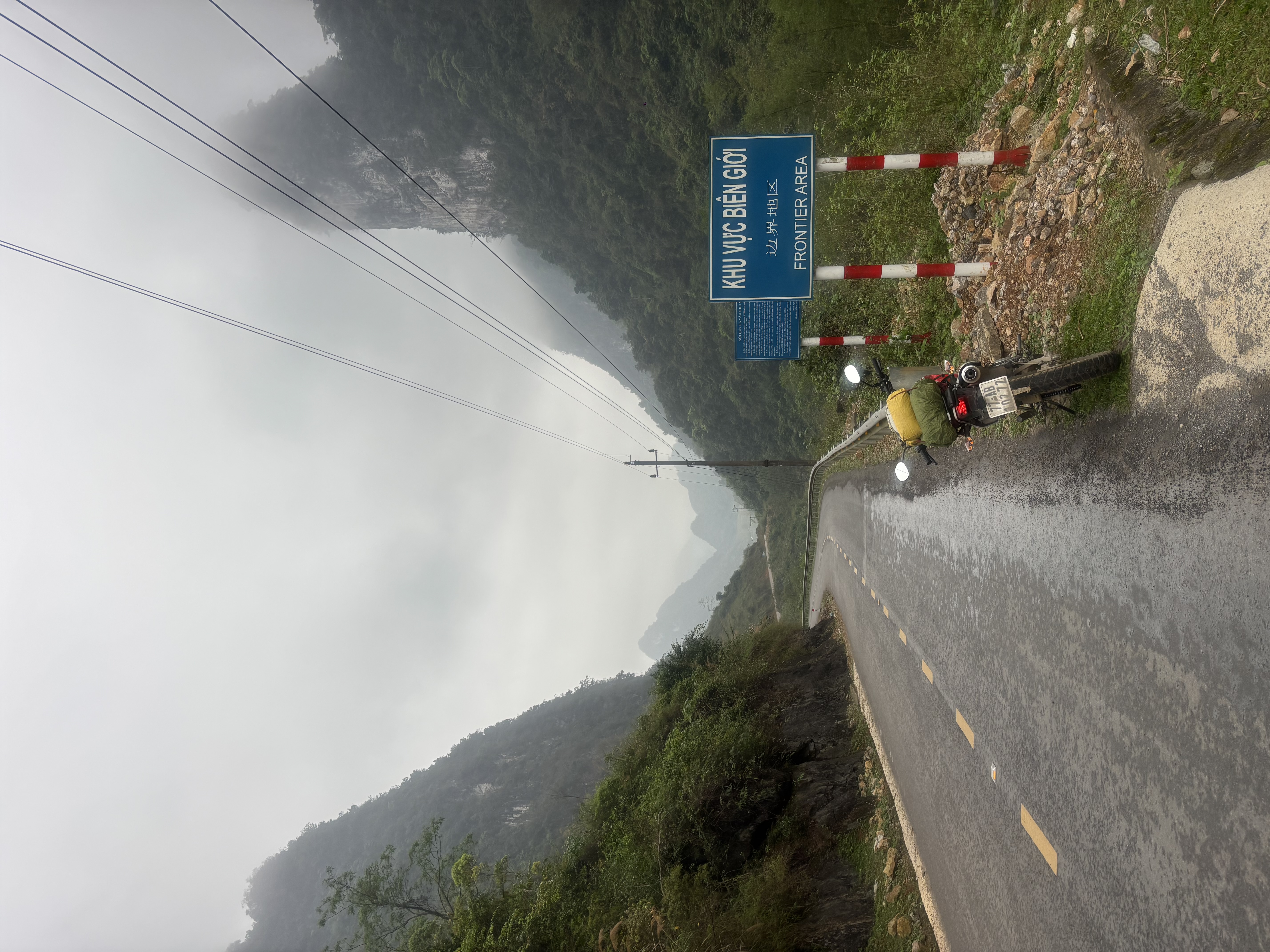
Motorbike at a Frontier Area sign on a mountain road along the Chinese border
🧭

The Route — Into Border Country

Mèo Vạc → Bảo Lạc (~80 km, 3-4 hrs) → Cao Bằng City (~125 km, 4-5 hrs) → Bản Giốc Waterfall (~85 km) → then south via Ba Bể Lake back to Hanoi. Total extension: 5-7 days of riding through limestone valleys, minority villages, and border country.

Roads are QL4C and QL34 — paved throughout but some rough patches and potholes between Bảo Lạc and Cao Bằng. March is dry season, conditions near their best. Fill up at every fuel stop — services are sparse on some stretches.
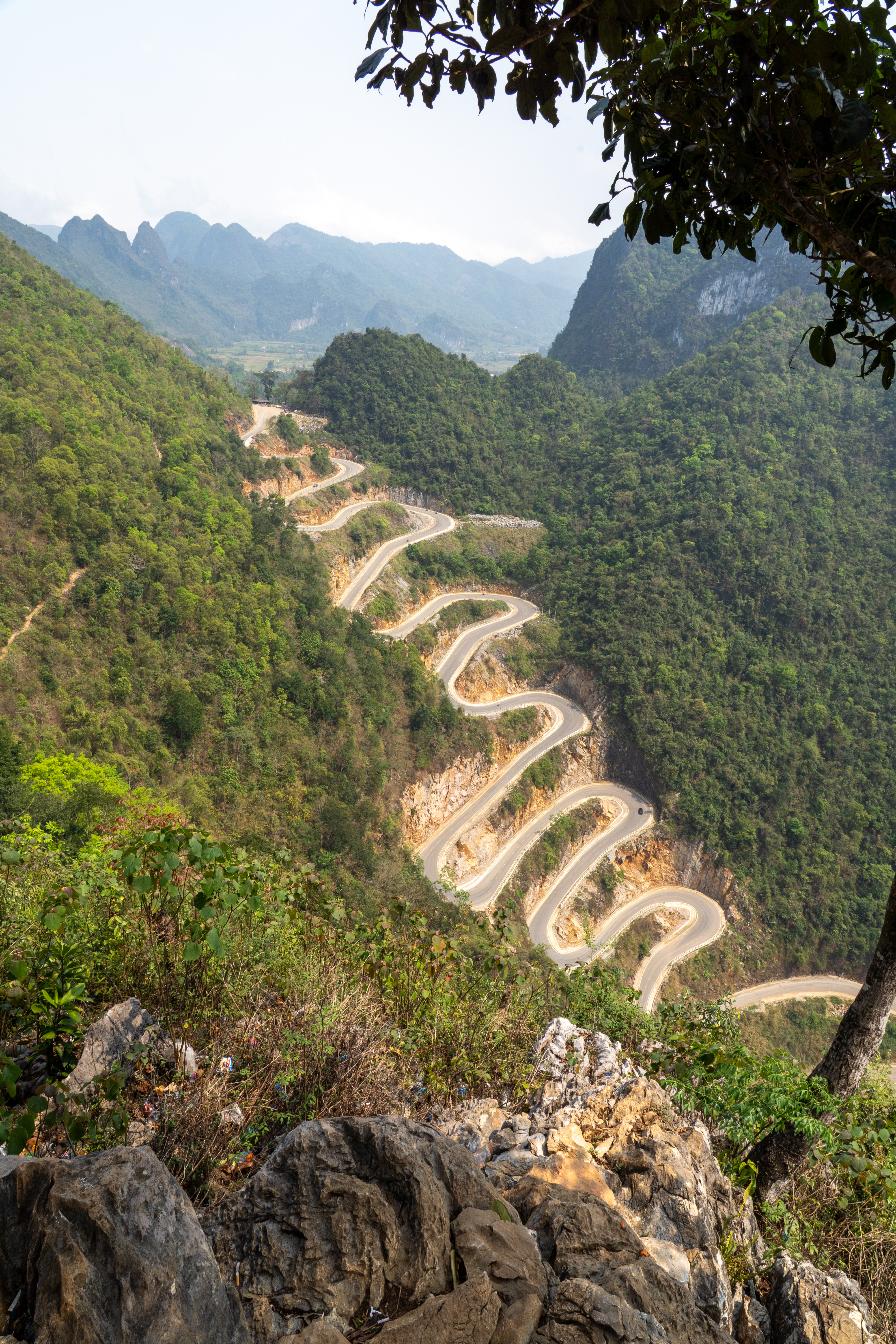
Đèo Mẻ Pia — 14 hairpin switchbacks carved into the mountainside between Hà Giang and Cao Bằng
🏘️

10. Bảo Lạc — Via the Dragon's Stairway

The road east from Mèo Vạc climbs through Đèo Mẻ Pia — the "14-Storey Pass" — fourteen hairpin switchbacks carved into a jungle mountainside. One of the most spectacular passes in the north. Then down into Bảo Lạc, a small town on the Gâm River. A natural overnight before the longer push east to Cao Bằng.

~80 km from Mèo Vạc · 3-4 hrs riding · Fuel available

Stay: Bảo Lạc Homestay Hostel & Coffee — garden, pool table, WiFi. Walk-up, no booking needed.

🏙️

11. Cao Bằng City — Base Camp

Provincial capital and gateway to Bản Giốc. Not a tourist town — a real working Vietnamese city in the mountains. Good food (local specialties: sour phở, roasted suckling pig, rice rolls with bone broth), fuel, ATMs, and everything you need before heading to the waterfall.

~125 km from Bảo Lạc · 4-5 hrs riding · Full services

Stay — Budget: Cao Bằng Eco House — dorm beds and private rooms. Rated 9.6 on Hostelworld.

Stay — Nicer: PIA Homestay — mountain and garden views, on-site motorbike rental and free loop maps.
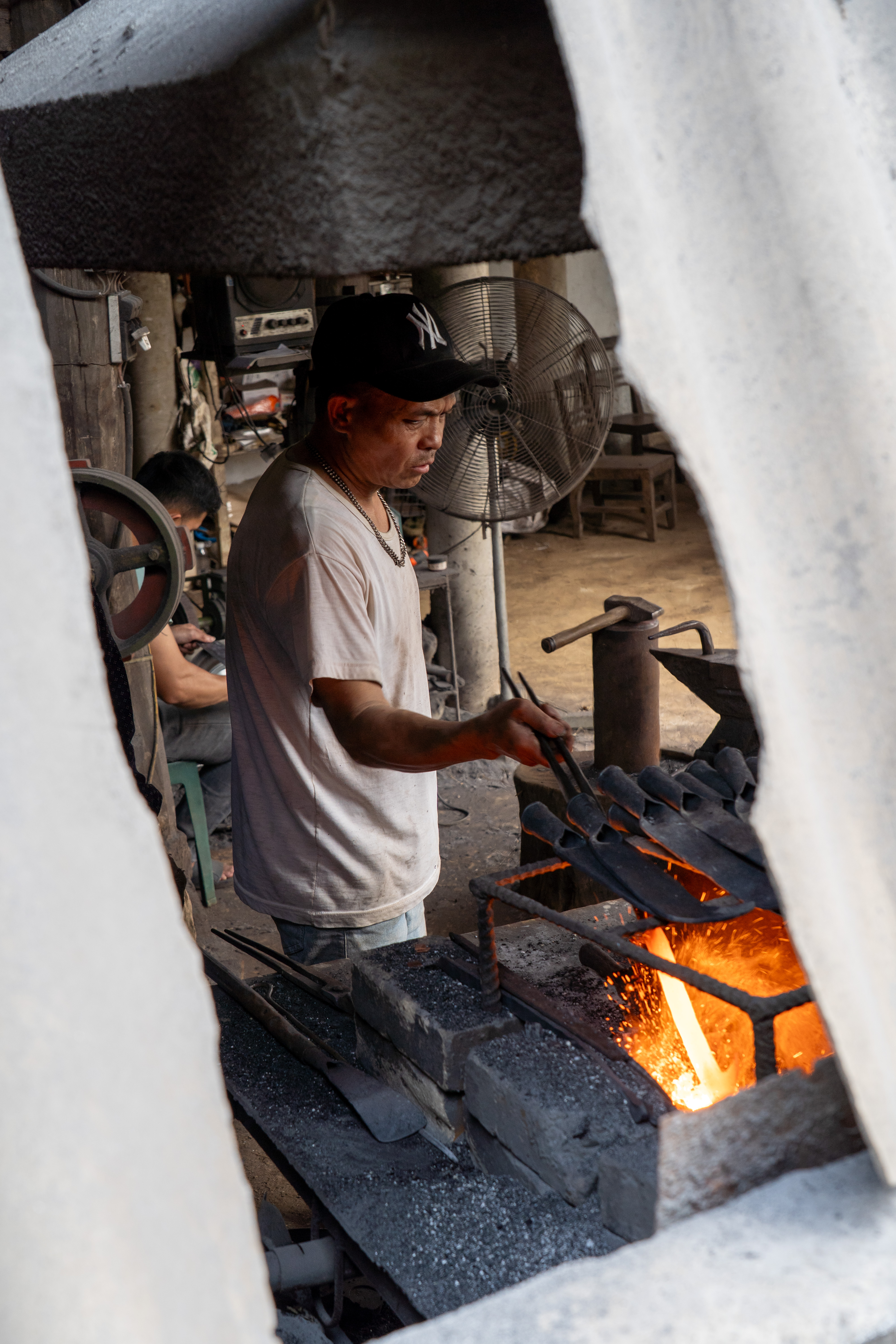
Blacksmith at the forge in Phúc Sen village
⚒️

Phúc Sen Blacksmith Village

Traditional knife-making craft village, ~30 km east of Cao Bằng on the road to Bản Giốc. Families forging knives and tools by hand over open coal fires — one of Vietnam's last working blacksmith villages. Free to wander through the workshops and watch the process up close.
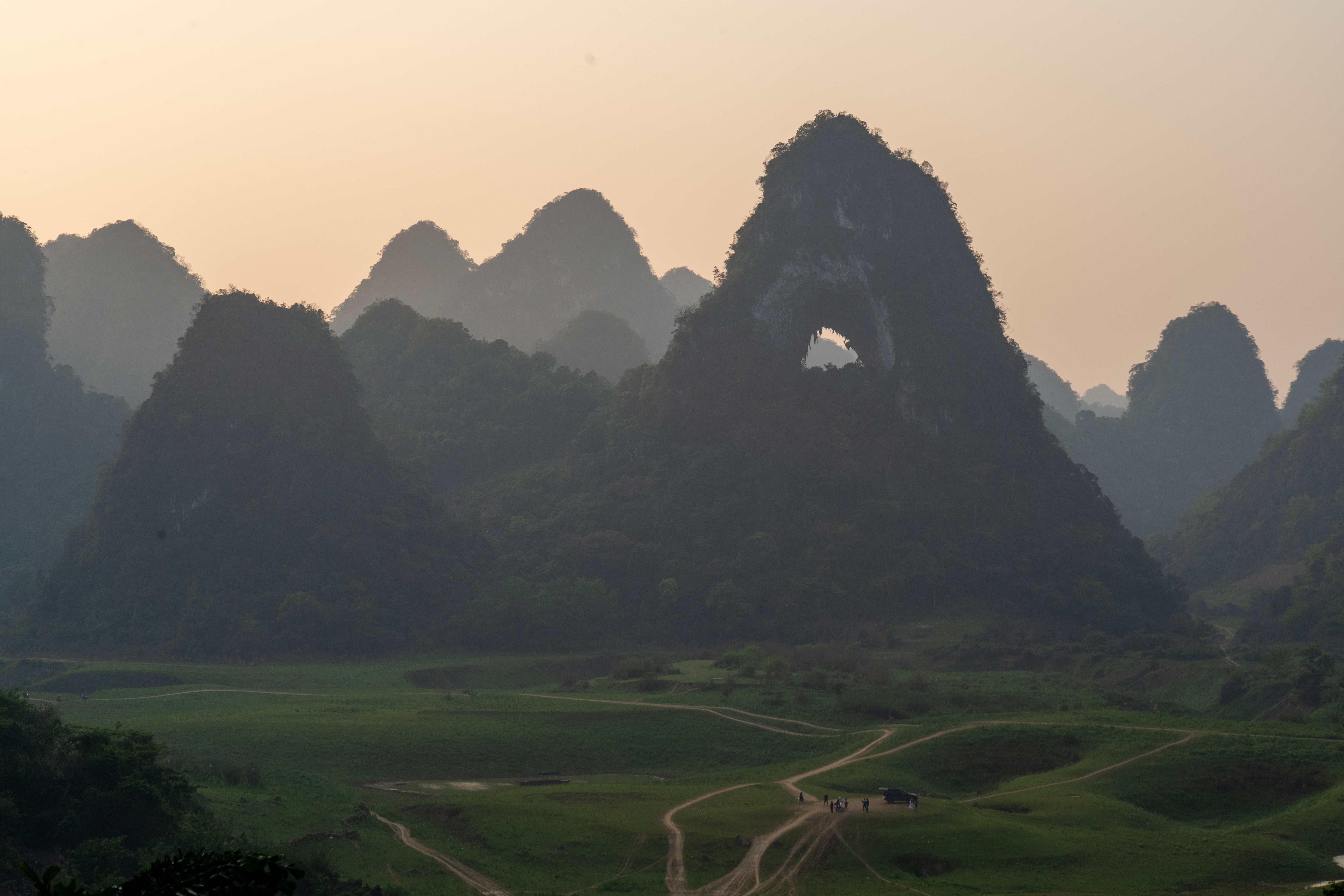
Mắt Thần — Angel Eye Mountain at golden hour, karst silhouettes layered in golden haze
🏔️

Angel Eye Mountain (Núi Mắt Thần)

A mountain with a natural hole/cave through its centre, overlooking a karst valley. Photogenic viewpoint between Cao Bằng city and Quảng Uyên, right on the road to Bản Giốc — easy stop en route. Google Maps directions to this one can be dodgy — search for "Cao Bang Eco Camping" as a fallback, then ask locals for the final approach. ~1.5 km walk through rice paddies to the viewpoint.

💧

12. Bản Giốc Waterfall

Vietnam's largest waterfall, right on the Chinese border — the water literally straddles the boundary. 30 metres high, 300 metres wide. Fourth largest transnational waterfall in the world. A bamboo raft takes you up close to the base — expect to get a bit wet. You can see the Chinese side and wave across. Spectacularly remote and genuinely uncrowded.

~85 km from Cao Bằng city · Small entry fee · Bamboo raft available

March is dry season — lower water volume than peak (Sep-Nov) but clearer skies. Still very impressive. Fill up on fuel before leaving Cao Bằng.

🦇

13. Ngườm Ngao Cave

Massive cave system ~5 km before Bản Giốc — 2,144 metres total length, 948 metres open to visitors. Spectacular stalactites and stalagmites. Less crowded than Phong Nha's caves. Since you're already at the waterfall, this is a no-brainer stop.

~5 km from Bản Giốc · Small entry fee · Optional advanced guided route available

🏡

Khuổi Ky Stone Village — Overnight

Historic Tày ethnic minority village of stone houses, ~5 km before Bản Giốc on the approach road. Multiple homestays available — this is the recommended base for the waterfall area rather than staying in Cao Bằng city. Family-cooked meals, quiet riverside setting.

Stay: Minh Khang Homestay (8th generation family), Lan Rừng Homestay, or Hoàng Công Homestay — budget range. Walk-up, no booking needed outside Vietnamese holidays.

🌊

Thang Hen Lake

A system of 36 interconnected lakes in karst valleys, connected through caves and underground passages. At over 1,000 metres altitude — 10 km mountain pass to reach it. In March (dry season) the lakes are separate pools with their own character. ~30 km from Cao Bằng city, half day trip.

~30 km from Cao Bằng · Small entry fee · Half day

Return to Hanoi

↩️

Return Route — Via Ba Bể Lake (Recommended)

Cao Bằng → Ba Bể Lake (~120 km, 4-5 hrs): South on QL34 through Nguyên Bình district. The road is well-paved through remote limestone valleys. Fill up in Chợ Rã — last town before the lake.

Ba Bể is one of Vietnam's largest natural freshwater lakes — three connected lakes stretching 8 km through a mountain-ringed national park. Far from the tourist circuit. Boat trips through Puông Cave (a 300m river cavern full of bats), Dầu Dăng Waterfall, kayaking, trekking to Tày and Hmong villages, and Hua Ma Cave (massive stalactite chambers). Aaron's suggested 2-3 nights in a lakeside Tày homestay — explore by day, recharge by evening. Full details in the Now section above.

Ba Bể → Hanoi (~240 km, full day): Via Bắc Kạn and Thái Nguyên. The classic loop closure — Hà Giang → Cao Bằng → Ba Bể → Hanoi. Turns the whole northeast into one big loop.

Alternative: Cao Bằng → Lạng Sơn → Hanoi direct (~315 km, 1-2 days). Faster but less scenic. Could stop in Bắc Sơn Valley for photogenic rice terraces.

📋

Cao Bằng Practical

Duration: 5-7 days total from Mèo Vạc back to Hanoi (including Ba Bể).

Budget: Very affordable — same range as Hà Giang. Accommodation, meals, and fuel are all cheap.

Fuel: Fill up at every opportunity. Sparse between Bảo Lạc and Cao Bằng. Cao Bằng city has plenty. Fill up before riding to Bản Giốc (85 km each way).

Road conditions: QL34 from Bảo Lạc passes through Tĩnh Túc (old mining town, superb scenery) and Nguyên Bình — paved but unpredictable surface in patches. March (dry season) is near best conditions. Winding mountain roads throughout.

No booking needed: Walk-up homestays and guesthouses at every stop. Budget range throughout.
============================================ -->

Phong Nha & North

From Phong Nha, the trip entered its final group chapter. Aaron and Tom rode north through tea hills and karst valleys. Brad headed south by sleeper bus. Issy and Sev made their own way to Hanoi. At Pu Luong, the last four said goodbye on 20 March — six weeks after it all started in Đà Lạt.

Huế → Phong Nha

~210 km · One full day riding

🦇

Phong Nha-Ke Bang National Park — Done

Three nights at Central Backpackers Hostel. UNESCO caves, underground river systems, and a karst landscape 400 million years in the making. The whole group was here together one last time before scattering.

Caves explored: Paradise Cave (jaw-dropping scale, wooden walkways through vast chambers), Phong Nha Cave (explored by boat on the underground river), Dark Cave (zipline entry, swim through darkness, mud bath). The Bong Lai Valley Loop by motorbike — countryside, riverside cafes, swimming spots.

Tea Hills → Ninh Bình → Pu Luong

🍃

Gio Lao → Ninh Bình — Done

Aaron and Tom rode north from Phong Nha on the 15th, overnighting at Gio Lao Eco Lodge — a bungalow on a "tea island" in the Nghệ An highlands. Then ~300 km to Ninh Bình in one long day — Ho Chi Minh Highway through the scenic highlands, cutting east to QL1A at Thanh Hóa for the final stretch.

🏔️

Ninh Bình — Done

Two nights at Tam Cốc. Sunrise hike up Dragon Mountain (Mua Cave) — 500 steps to the panoramic lookout over rice paddies and karst formations. Met up with Sev and Issy for the last time before they headed to Hanoi. Boats through cave-riddled karst waterways.

🌾

Pu Luong — Done

Two nights at Gateway Inn in Pu Luong Nature Reserve. Terraced rice paddies cascading down limestone valleys, bamboo forests, waterfalls. Completed a half-marathon-length circuit around the reserve. The last place the group of four was together — Sev and Issy headed to Hanoi, Tom and Aaron continue north.

Practical Info — Tickets & Booking

Almost everything on the northbound route is walk-up — no advance booking needed. Here's the breakdown.

🎫

Walk-Up — Just Show Up

Marble Mountains: Small entry fee. Am Phu Cave and elevator are extra. Open 7am–5:30pm. Allow 2–3 hours.

Son Tra Peninsula: Free, no tickets. One catch — automatic scooters are banned from the upper mountain roads (barriers enforced). Linh Ung Pagoda (Lady Buddha) is still accessible on automatics, but Ban Co Peak and summit viewpoints need a manual bike or car.

Huế — Imperial Citadel + Royal Tombs: Combo ticket at Ngo Mon Gate — Citadel + all 3 tombs (Khai Dinh, Tu Duc, Minh Mang). Valid 2 days. Audio guide available at the Citadel for extra. Open 6:30am–6pm.

Perfume River boat: Walk up at the piers. Negotiate a boat to Thien Mu Pagoda — prices are negotiable, round trip.

🦇

Walk-Up — Phong Nha Caves

All three main caves are walk-up, no booking needed:

Paradise Cave: Self-guided boardwalk through vast chambers, buggy ride included. Jaw-dropping scale.

Dark Cave: Full package — zipline entry, kayak, mud bath, cave swim. Best value experience in Phong Nha.

Phong Nha Cave: Entry fee plus a boat (fits up to 12, share with others or hire your own). The boat takes you into the cave via underground river.

Open 7am–4:30pm daily. Caves are a constant 18–20°C inside. March is excellent timing — low rainfall, stable water levels, no closure risk.

🏞️

Walk-Up — Ninh Binh

Trang An boat tour: 2.5–3.5 hours drifting through caves and karsts. The better pick for March — Tam Coc's rice paddies don't turn golden until June.

Mua Cave viewpoint: 500 steps to the iconic panoramic lookout over the valley.

Bai Dinh Pagoda: Free entry. Electric cart available (recommended — the complex is huge).

📋

Book Ahead

Oxalis adventure caves (optional): Hang En — 3rd largest cave in the world, overnight camp inside. Tu Lan 1-day experience. Hang Tien day cave trek. All through Oxalis, book ahead — walk into the Phong Nha office for the best availability. Son Doong is fully booked for all of 2026.

============================================ -->

Hai Van Pass to Huế

The road north began. Aaron, Tom, Issy, and Marcella rode through Hai Van Pass with Easy Riders guides — rained most of the way, arrived in Huế soaked but happy. Severine and Brad skipped the ride and bussed straight through to Phong Nha.

⛰️

Hai Van Pass — The Ride

One of the best coastal roads in the world — and they got it in the rain. 21 km of switchbacks where the Truong Son Mountains meet the South China Sea. Aaron and Tom rode their own bikes as a tag-along with the Easy Riders. Issy and Marcella rode pillion with the guides. Stopped for oysters and a vegetarian lunch along the way.

🏍️

Transport Split

On bikes: Aaron (XR150) and Tom (GD110) — tag-along with Easy Riders.

Pillion: Issy and Marcella rode with the Easy Riders guides.

By bus: Severine and Brad bussed straight from Hoi An through to Phong Nha — skipping Huế entirely.

🏠 Tue Night

Hue Happy Homestay — Huế

Aaron, Tom, and Issy stayed at Hue Happy Homestay. Marcella found a different hostel in Huế. Dinner together at Mrs Truong's restaurant nearby. Aaron, Issy, and Tom got massages at a place nearby.

Onward to Phong Nha

🧭

The Road Continues

Everyone's heading to Phong Nha. Severine and Brad are already there. Issy took a morning bus. Aaron and Tom are riding the bikes — 210 km through to the caves. Marcella deciding between pillion or bus. See the full northbound plan.

============================================ -->

Lo Xo Pass to Hoi An

From the highlands, Aaron and Tom rode north on the Ho Chi Minh Highway — through mountain passes, jungle switchbacks, and ethnic minority country — before turning east to Hoi An. The centrepiece: Lo Xo Pass, one of Vietnam's legendary motorcycle roads. Two days, ~320 km, 100% highlands until the final descent to the coast.

🏍️

The Ride — Highlands to Hoi An

~320 km · 2 days riding

QL14 north from Kon Tum — the Ho Chi Minh Highway. Through Dak To, along river valleys and ethnic villages to Dak Glei, then up and over Lo Xo Pass. Overnight in Kham Duc, then east on QL14B to Hoi An. All paved tarmac, but remote — sparse fuel between Dak Glei and Kham Duc, potential fog at elevation, livestock on the road. The XR150 and Tom's GD110 will both handle it.

📜

Dak To

About 45 km north of Kon Tum. A quiet highland town with heavy history — the Battle of Dak To in 1967 was one of the bloodiest engagements of the American War. Charlie Hill (Hill 875) is nearby. The road passes through river valleys and Sedang ethnic villages.

⛰️

Lo Xo Pass

The centrepiece of this route and one of the best motorbike roads in Vietnam. 20+ km of switchbacks through dense jungle on the flanks of Ngoc Linh — at 2,598m, the highest peak in central and southern Vietnam. The jungle "melts over mountains like candle wax." Cinnamon-scented descent into the valley on the far side.

Vietnam Coracle rates this as a must-ride. The road climbs from the Dak Glei river valley up through the cloud forest and drops down the other side into a completely different landscape. World-class riding through terrain that very few tourists ever see.

🏠 Overnight

Kham Duc

Small town on the far side of Lo Xo Pass — the natural overnight stop. Basic guesthouses, refuel, rest. From here it's east to the coast and Hoi An.

Hoi An — The Reunion

🏮

About Hoi An

A UNESCO World Heritage ancient town on the central coast. Former trading port with Japanese, Chinese, and Vietnamese architecture layered over 400+ years. Lantern-lit streets along the Thu Bon River, ancient merchant houses, the Japanese Covered Bridge, Chinese assembly halls, and some of the best food in Vietnam — cao lầu, mì quảng, and the legendary bánh mì.

The kind of place where you go for two days and stay for a week. Tailors on every corner, cooking classes, bicycle rides through rice paddies, and beach just 4 km away.

👥

The Group Reunites — Plus One

The milestone. Marcella had been in Hoi An since early March. Issy and Severine made their way up from Quy Nhon. Aaron and Tom rode in from the highlands. All paths converged on Hoi An.

And a new face — Brad, from Manchester (via northern Switzerland), met at the hostel and clicked with the group immediately. Film photographer and Pentax shooter. He joined the crew and headed north with the group from here.

🤿

Cù Lao Chàm — Diving Option

The Cham Islands are a UNESCO marine park about 20 km offshore from Hoi An. Multiple PADI 5-star dive centres operate out of Hoi An — Open Water courses run over 3 days, typically starting Monday or Thursday. March conditions are properly into season. A possibility for anyone keen on getting underwater.

============================================ -->

Deeper into the Highlands

The group scattered. Issy and Severine caught a bus from BMT directly to Quy Nhon on the coast. Aaron and Tom saddled up the bikes and headed north — deeper into the Central Highlands. Through Pleiku, past the volcanic crater of Biển Hồ, and into the Ba Na territory of Kon Tum province.

🏍️

The Ride — BMT → Pleiku → Highlands

~240 km · 5-6 hours riding

QL14 north — the Ho Chi Minh Road. Well-paved two-lane highway through rolling coffee country, red basalt soil, rubber plantations, and scattered Ede and Jarai villages. Through Pleiku (Vietnam's highland coffee town at 750m elevation) and on into the highlands — the northernmost reach of the Central Highlands, where Vietnam meets Laos and Cambodia.

🌋

Biển Hồ — Sea Lake

A flooded volcanic crater 7 km north of Pleiku. 230 hectares of crystal-clear water surrounded by ancient pine forest, at 800m elevation. The Jarai people call it T'Nung — "sea on the mountain." Legend says a village was buried in an eruption and the survivors' tears filled the crater. Best early in the day when mist sits on the water.

Pleiku

Not a tourist town — that's the appeal. Highland city at 750m, often misty, cooler than the coast. Coffee on every corner. If you stop, try pho kho (dry pho, the local specialty).

🏘️

About Kon Tum

In the Ba Na language, Kon means village and Tum means lake. This is the northernmost Central Highlands — the "Indochina junction" where Vietnam, Laos, and Cambodia meet. Far fewer visitors than anywhere else on this trip. The Ba Na, Jarai, and Sedang ethnic minorities have lived here for centuries, and their culture is everywhere — soaring communal houses, traditional villages, and rituals that haven't changed in generations.

The Dak Bla River runs through town, crossed by the Kon Klor suspension bridge with views of the villages beyond. For food, the local specialty is leaf salad — a plate of 40+ different forest leaves, herbs, and greens. Unlike anything you'll eat anywhere else in Vietnam.

Kon Tum Wooden Church

Built in 1913, blending Roman architecture with Ba Na stilt-house design. The surrounding grounds include a private museum with cultural items from local ethnic minorities. One of the more striking church buildings in Vietnam.

🏛️

Kon K'lor Communal House

Standing 22 metres tall and 17 metres wide — the largest communal house in the Central Highlands. A traditional Ba Na structure that symbolises community. The kind of architecture that makes you stop and stare.

🏘️

Kon K'Tu Village

A Ba Na ethnic village about 8 km from Kon Tum town. Simple, attractive traditional mud houses, a Catholic church, and a community that's been living on this land for centuries. Worth the short ride out.

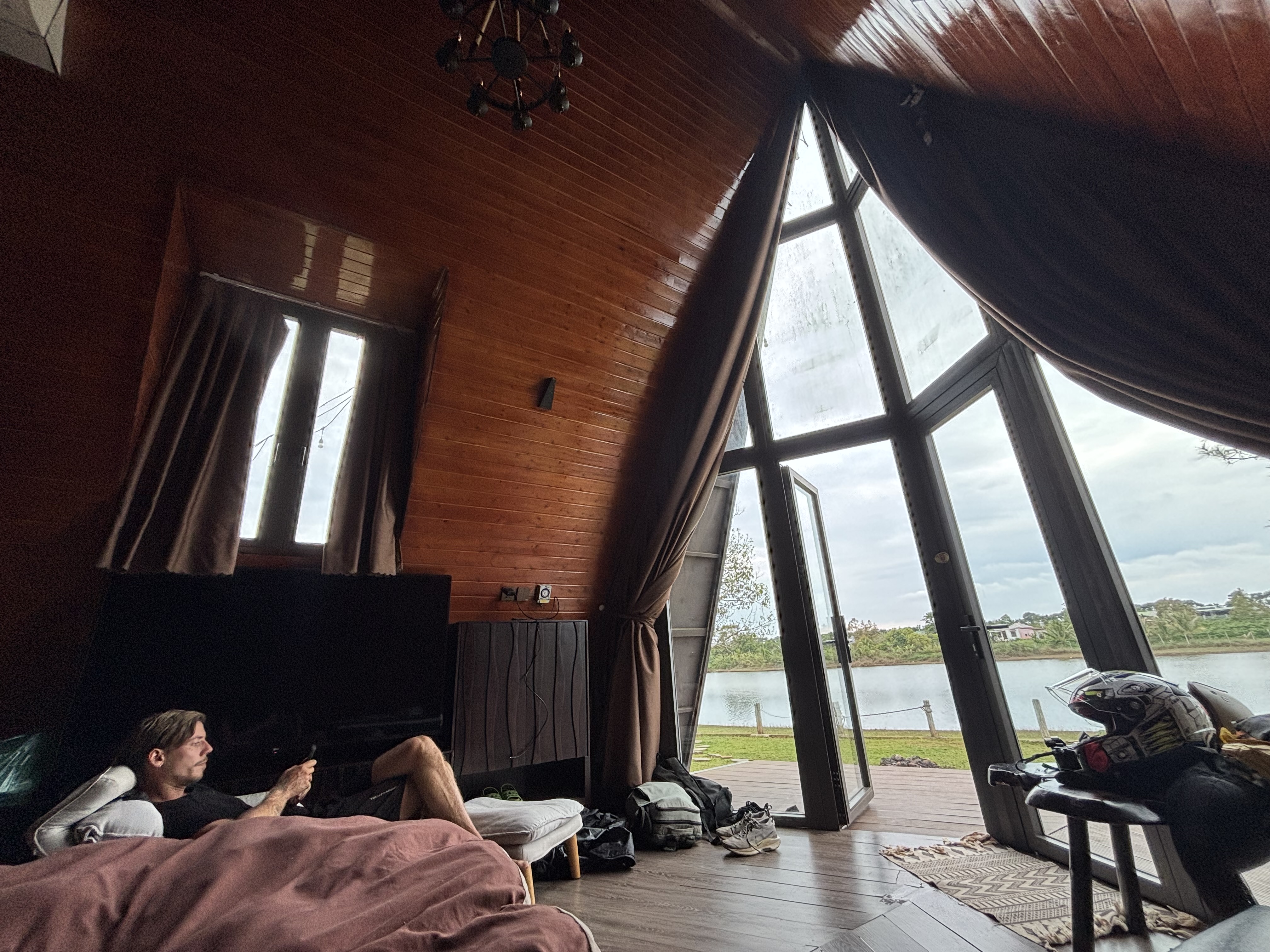
A-frame cabin with floor-to-ceiling windows overlooking a lake in the Central Highlands
🏠 Thu–Fri · 2 Nights

Lakeside Cabin — Biển Hồ

Tom found a cabin on a lake near Pleiku's volcanic crater. Planned for one night, extended to two — the kind of place that makes you slow down. Highland exploring and day trips before the big ride north.

============================================ -->
Wednesday

Wed 4 Mar — Elephant Day

☕ Coffee · 🍜 Vegetarian lunch · 🐘 Yok Don afternoon session

The last day in BMT. Morning coffee at SOUL Roastery, quick vegetarian lunch, then out to Yok Don National Park for the afternoon elephant observation session.

SOUL Roastery BMT

Specialty highland coffee roasted on-site. Modern, airy space in the coffee capital of Vietnam.

87 Nguyen Khuyen, Tân Lợi

🍜

Lunch (Vegetarian)

Early lunch before the park. Quán Cơm Chay Giác Đức on Ly Thai To St — Buddhist vegetarian, very cheap.

🐘

Yok Don National Park

Vietnam's first ethical elephant experience. No rides, no tricks — observed elephants roaming freely through dipterocarp forest while guides shared each elephant's story. Afternoon half-day session ran 1:30–4:30 PM. Electric car shuttle from reception to the elephant area (~12 km into the park).

Cash only · Book afternoon half-day session

============================================ -->
Day Trip

Waterfall Circuit

~40 km round trip from BMT · Dray Nur Falls

Day trip to Dray Nur — about 25 km south of BMT through coffee and pepper plantations. Aaron and Tom rode the bikes; Issy, Sev, and Marcella followed in a private car with a hired driver. Swam at the falls.

💧

Dray Nur Waterfall

Wide cascading waterfall on the Sêrêpôk River. One of the most powerful falls in the Central Highlands. We swam here.

============================================ -->
Monday

Mon 2 Mar — Lak Lake → BMT

~50km · Easy morning transfer

The riders headed back to Đà Lạt. We took in the lake in the morning, then made our own way to Buôn Ma Thuột — just 50km, about an hour. Marcella headed to Hoi An by bus — she'd said from the start she wanted to spend time there. That left four: Aaron, Tom, Issy, and Severine.

About Buôn Ma Thuột

Vietnam's coffee capital — this is where the beans come from. Completely off the foreign tourist map. Genuine local city life, Ede ethnic minority culture woven into the urban fabric, and coffee everywhere. Cafes on every corner, most growing their own beans.

Relaxed, authentic, and incredibly cheap. A base camp for waterfalls, national parks, and indigenous villages — but the city itself has character. Ako Dhong village is a 500-year-old Ede settlement right in the middle of town.

🌅

Morning on Lak Lake

Sunrise over Vietnam's largest natural freshwater lake. Dugout canoes on the water, M'nong longhouses, rice fields, mist. Absolute silence.

🏘️

Ako Dhong Village

500+ year-old Ede ethnic settlement just 2km from BMT city center. Traditional longhouses, gong culture, wooden sculptures. A living piece of history in the heart of Vietnam's coffee capital.

🏠 Mon–Wed · 3 nights

Happy Homestay — Buôn Ma Thuột

Recommended by Issy's friend — 9.3 rating, Ede cultural experiences, right in the coffee district. Our base camp for exploring BMT and the surrounding highlands.

============================================ -->
Sunday

Sun 1 Mar — Hit the Road

🌤️ Best weather · 27-28°C · ~160km · 5-6hrs with stops

8am departure from Tigon Hostel. Aaron organised Easy Riders for the group through Cong at Tigon — three riders. Aaron and Tom rode their own bikes. Cong turned it into a full day tour — Linh An Pagoda, then a loop through coffee plantations, dragonfruit farms, a coffee processing place, rice paper making, and a mushroom farm. One of Vietnam's most underrated roads.

🌊

About Lak Lake

Vietnam's largest natural freshwater lake, sitting in a wide valley surrounded by mountains and rice paddies. This is M'nong country — an indigenous minority group who've lived here for centuries. No tourists, no hostels, no party scene. Just a quiet village on a big lake.

Traditional stilt houses over the water, dugout canoes at sunrise, mist burning off the lake in the morning, chickens and buffalo wandering around. Meals cooked by the family — simple, local, delicious. Basic (mattress on the floor, mosquito net, outdoor bathroom) but that's the whole point. This is the real Central Highlands.

🏍️

The Ride

Aaron rode his Honda XR150, Tom his Suzuki GD110. Everyone else was with the Easy Riders — 3 riders booked through Cong at Tigon. Cong made a full day tour out of it with stops along the way.

Departed 8am from Tigon. Arrived Lak Lake late afternoon.

Highlights along the route:

🏛️

Linh An Pagoda

Hilltop temple with Vietnam's biggest female Buddha statue (~71m Guanyin), a 12.5m Maitreya Buddha, and a garden with ~500 identical Guanyin statues. Views over the valley from the temple grounds.

Free entry

🌿

Easy Rider Tour Stops

Cong and the riders organised a full day of stops along the route. A coffee plantation walking through the rows of arabica and robusta. A dragonfruit plantation — the bright pink fruit growing on cactus-like plants. A coffee processing facility showing the full bean-to-cup journey. A rice paper making workshop — watching the thin sheets dried on bamboo racks in the sun. And a mushroom farm growing shiitake and oyster mushrooms in dark humidity-controlled sheds.

All stops organised by the Easy Riders as part of the tour

Then onto QL27 north through 3 mountain passes and coffee country. Arrived Lak Lake late afternoon.

🏠 Sunday Night

Homestay at Lak Lake

Cong and the riders organised the homestay — they do this route regularly and knew exactly where to go. Traditional stilt house, meals included, very basic and very authentic.

============================================ -->
Saturday

Sat 28 Feb — Rain Day

🌧️ Rain most of the day · 22-23°C · Indoor day

A slow rainy day in Đà Lạt. Marcella and Issy headed into town for nails and a laundry drop-off. Sev found a neck and shoulders massage in the afternoon. Aaron played đá cầu — the Vietnamese shuttlecock game — with Matt and a local kid at Tigon, then went for a run. Night market in the evening — the kind of day you need before hitting the road.

💅

Nails & Laundry in Town

Walk-in nail salons along Nguyễn Văn Trỗi and Phan Đình Phùng. Laundry shops everywhere — same-day or next-morning return.

🏸

Đá Cầu at Tigon

Aaron played đá cầu — Vietnam's shuttlecock game — with Matt and a local kid at the hostel. A weighted shuttlecock with feathers, the same game played in schoolyards across the country. Five push-ups every time you drop the rally. Followed it up with a run. Sev got a neck and shoulders massage nearby. A slow afternoon otherwise.

Rain Cafes

Thuy Ta Coffee — glass conservatory on Xuan Huong Lake, watching the rain hit the water. UP Coffee — 3-storey glass, 180° city views. Dalat Nights Coffee — hilltop panoramic, open 24hrs. Perfect for sitting with a book while it pours.

Evening

🏮

Đà Lạt Night Market

A sprawling night market along the streets around Xuan Huong Lake. Street food stalls, grilled everything, soy milk, fruit shakes, Vietnamese pizza (bánh tráng nướng). The place was buzzing.

Free entry · Every evening from ~6pm

============================================ -->

Đà Lạt — Before the Road

Five solo days in a mountain town before everything changed. Đà Lạt sits at 1,500 metres in the Central Highlands — pine forests, French colonial architecture, flower farms, and a backpacker scene centred around Tigon Hostel. Went canyoning on day two, picked up the motorbike on day three. Over the next few days, the people who would become the group appeared one by one.

🏠

Tigon Hostel

The social hub of backpacker Đà Lạt. Đá cầu games in the courtyard, communal dinners, a whiteboard of local recommendations, and the kind of energy where strangers become travel partners within a day or two. Aaron checked in the afternoon he arrived from Mũi Né.

🧗

Canyoning

Day two — rappelling down waterfalls, cliff jumping, natural waterslides through the Đà Lạt jungle. Went with Marcella, a Dutch elopement photographer also staying at Tigon. The first real adventure day of the trip.

🏍️

The Bike

Picked up a Honda XR150 from Tigit Motorbikes. A proper dual-sport — built for Vietnam's mountain roads. This would be home for the next two months, from the highlands to Hà Giang and back. The start of something.

Em Ta Nung

Day trip with Sev to a coffee farm on the outskirts of town. Sat in the tower and spotted a white-throated kingfisher with electric blue feathers while the sun poked through rain clouds. Salted cream coffee and strange cheese-flavoured chips. A big Buddha statue with chaotic internal stairs and questionable electrical wiring. Bird calls imitated together on the way back. Rode home in the rain, wringing out socks.

🤝

The Crew Forms

One by one, the group came together at Tigon. Marcella — Dutch, an elopement photographer who'd been travelling solo. Severine — Swiss, up for anything. Issy — had a homestay connection in Buôn Ma Thuột. Tom — German, arrived on a Suzuki GD110, found out about the plan on the last night and said he was in. Everyone wanted to ride together — they just needed someone to make the plans. Aaron built this site to coordinate. Departure set for Sunday 1 March.

The solo chapter ends here. What started as one person on a train to the coast was now five people with two motorbikes and a plan. Next: the rain day before everything starts moving.

============================================ -->

Mũi Né Through Tết

Twelve days in a beach town on Vietnam's southeast coast. Arrived by train, rented a scooter, and stayed through Tết — Vietnamese New Year — when the whole country slows down. This was the decompression chapter: sand dunes at sunset, fishing boats at sunrise, the rhythm of a place with nowhere to be. People came and went. Some of them became genuine friends.

🏨

Fairy Hills Hotel

Home base for the full two weeks. Started in the dorm — moved to a private room after the water pump in the dorm cycled on and off every thirty seconds all night. The upgrade changed everything: space to spread out, a door that locked, actual sleep. Rented a Honda PCX scooter for day trips along the coast.

🏜️

The Sand Dunes

Mũi Né's red and white sand dunes — the iconic landscape of the coast. The red dunes at sunset, the white dunes at sunrise. Aaron started running to the top of the red dunes — it became a daily ritual, the kind of anchor you need when everything else is new.

❤️

Mark & Jenny

Friends at the hotel who became family for a fortnight. They brought balut — fertilized duck egg — from the Saturday night market. Aaron tried it. It did not agree with him. What followed was a full day confined to his room. Mark texted late that night to check in, then showed up the next day with a bag of medicines. Jenny made congee and ginger-lemon-honey tea for days. The kind of care you don't expect from people you met a week ago.

🎆

Tết — Vietnamese New Year

The whole country pauses. Shops closed, locals visited family, the beach emptied out. A week of slow mornings, scooter rides along the coast, and fruit from the market. Daria and Elena — Russian travellers from the hotel — departed on the first day of Tết. The late-night meowing-melody song game with three Russians the night before was the send-off.

✍️

Igor & the Short Story

Met Igor, a writer staying at Fairy Hills, toward the end of the two weeks. He shared some of his short fiction. Something clicked. Aaron wrote his first short story — inspired by a run up to the top of the red sand dunes and the view from the summit. A new creative outlet, born from a quiet afternoon in a beach town.

After two weeks of landing, decompressing, and finding a rhythm — a limousine bus to the highlands. Five hours climbing from sea level to 1,500 metres.

============================================ -->

Landing in Saigon

Flew in from Perth on a delayed VietJet flight. Golden hour through the plane windows towards the end — sun pouring through, that feeling of gratitude you get when you're heading somewhere new. Fifty-minute Grab ride into the city. First-ever hostel stay, first night out in the backpacker district, first taste of being completely untethered. By day two, the city's noise and infinite choice had already pointed the way south.

🛬

Arrival — District 1

Checked into a hostel next to Lillie's in the Bùi Viện backpacker area. First-ever hostel stay. The energy was immediate — music from every bar, motorbikes everywhere, neon signs reflecting off wet streets.

🍻

First Night Out

Met Josh from Bristol and Dorota from Poland at the hostel. Cheap beers on Bùi Viện, then a sports bar with a live band and pool table. Social momentum in full swing — the kind of night where you say "just one more" about four times.

🍜

Finding Feet

Day two. Walked District 1 on foot. First phở, first bánh mì. Researched Vietnamese hyperinflation after noticing the currency denominations — post-war reunification policies in the 80s, still unresolved. That curiosity-through-lived-experience approach to travel: learn from the place itself, not a guidebook.

🚂

The Decision — Head South

The city was too much, too fast. Needed somewhere quieter to land properly. Booked a train from Saigon Railway Station to Phan Thiết — four hours down the coast to Mũi Né. Beach, sand dunes, fishing boats. A place to breathe.

Road & Weather

🛤️

Roads North

Hoi An → Huế: Well-paved throughout. Hai Van Pass is 21 km of switchbacks — can be foggy mornings, watch for oil slicks on the northern descent. Huế → Phong Nha: 210 km on QL1A, good road. Phong Nha turn-off is 40 km inland from Dong Hoi — narrower road into the national park.

🌧️

Weather — Mid to Late March

Rain cleared after Phong Nha — the ride north from the 15th was dry. Late March forecast: Dry and sunny through to month's end. Highs 25–28°C on the coast, cooler inland. Ninh Bình should be clear and warm. Pack a light layer for Pu Luong if taking the highland route — cooler at elevation.